

Updated · Originally published
Are you having trouble understanding the difference between ERP vs CRM systems? As a Microsoft gold partner, we have witnessed many businesses grappling with this issue. It's important to note that these two software types have distinct features and functions.
In this post, we will delve into the key differences between ERP and CRM systems and assist you in determining the best fit for your business.
What is ERP?
ERP, or Enterprise Resource Planning, is a software system that helps businesses manage their core business processes, including finance, human resources, manufacturing, and supply chain management. An ERP system provides a centralized platform for managing these processes, allowing businesses to streamline operations, reduce costs, and improve efficiency.
An ERP system can help businesses in a variety of ways, including:
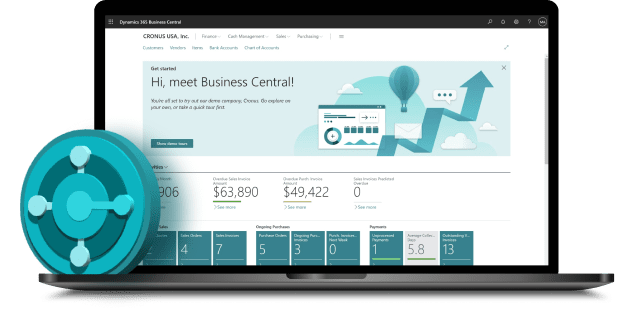
Improved financial management: An ERP system can help businesses manage their finances by providing real-time financial data, automating accounting processes, and generating reports. This can help businesses make better financial decisions and ensure compliance with regulations.
Enhanced supply chain management: An ERP system can help businesses manage their supply chain by providing visibility into inventory levels, tracking shipments, and optimizing procurement processes. This can help businesses reduce costs and improve efficiency throughout the supply chain.
Better human resource management: An ERP system can help businesses manage their human resources by providing tools for recruiting, training, and performance management. This can help businesses attract and retain top talent, leading to increased productivity and employee satisfaction.
What is CRM?

CRM, or Customer Relationship Management, is a software system that helps businesses manage their interactions with customers, clients, and prospects. A CRM system is designed to improve customer relationships by providing a centralized platform for storing customer data, tracking customer interactions, and automating certain processes.
A CRM system can help businesses in a variety of ways, including:
Improved customer engagement: With a CRM system, businesses can track all customer interactions, including emails, phone calls, and social media interactions. This can help businesses provide more personalized and effective customer service, leading to increased customer satisfaction and loyalty.
Better sales performance: By tracking customer interactions, a CRM system can provide valuable insights into customer behavior, preferences, and needs. This can help sales teams identify new opportunities and tailor their sales approach to individual customers, leading to increased sales and revenue.
Enhanced marketing campaigns: A CRM system can provide businesses with detailed customer data, allowing them to create more targeted and effective marketing campaigns. By segmenting customers based on their behavior and preferences, businesses can deliver personalized messages and offers that resonate with their audience.
ERP vs CRM: What’s the Difference?
While CRM and ERP systems share some similarities, they are designed to address different business needs. The main difference between CRM and ERP systems is the scope of their functionality.
CRM systems are designed to manage customer interactions and relationships, while ERP systems are designed to manage core business processes. While a CRM system improves customer engagement, sales performance, and marketing campaigns, it lacks the functionality of an ERP system for managing finances, supply chain, and human resources.
An ERP system lacks the functionality for managing customer interactions that a CRM system provides. While an ERP offers insights into business operations, it doesn't track customer interactions and provide personalized customer service like a CRM.
Which System is Right for Your Business?
Determining which system is right for your business depends on your specific needs and goals. If your business primarily focuses on managing customer interactions and relationships, a CRM system may be the best choice. If your business needs to manage core business processes, such as finance, supply chain, and human resources, an ERP system may be the better option.
However, it’s important to note that many businesses use both CRM and ERP systems in conjunction with each other. This can provide a comprehensive solution for managing both customer interactions and core business processes. By integrating CRM and ERP systems, businesses can gain a more holistic view of their operations and make better-informed decisions.
When choosing a CRM or ERP system, it’s important to consider factors such as functionality, scalability, ease of use, and cost. It’s also important to choose a system that can integrate with other software and systems that your business uses.
Features |
ERP |
CRM |
|---|---|---|
| Functionality | Manages core business processes | Manages customer interactions |
| Focus | Back-end operations | Front-end operations |
| Data | Financial, supply chain, HR, inventory | Customer data |
| Automation | Accounting, procurement, inventory | Sales, marketing, customer service |
| Reporting | Generates financial and operational reports | Generates sales and marketing reports |
| Scalability | Scales with business growth | Scales with customer base growth |
| Integration | Integrates with other systems | Integrates with other systems |
| Cost | Can be expensive due to extensive functionality | Typically less expensive than ERP |
ERP and CRM Integrations
As businesses continue to grow, the need for efficient and streamlined operations becomes more critical. One way to achieve this is through the integration of ERP and CRM systems. ERP systems are designed to manage core business processes, such as financials, supply chain, HR, and inventory. On the other hand, CRM systems are focused on managing customer interactions.
While these systems have distinct functionalities, there is often a need for them to share data. This can be achieved through technical integration, which eliminates the need for maintaining separate sets of data. Example: Sales reps require access to a customer's order history and credit status for upsell or cross-sell campaigns, while finance needs the CRM system to calculate sales commissions and bulk order discounts for payroll.
Moreover, a CRM system built on top of an ERP platform can offer several advantages to business leaders. A consolidated ERP and CRM system enables businesses to analyze pricing structures and track KPIs, such as customer acquisition costs and lifetime value.
One critical process that requires tight integration between CRM and ERP is configure, price, and quote (CPQ). CPQ tools are vital for many businesses and require information from both the CRM and ERP systems. Prebuilt integrations for larger CRM and ERP vendors are pricey and difficult to maintain during system upgrades.
Maximizing Business Efficiency with a Unified ERP and CRM Solution
In today's highly competitive business environment, companies need to adopt innovative solutions to streamline their operations and stay ahead of the competition. One such solution is to unify ERP and CRM systems, which can offer several advantages for businesses. Adding a CRM system to ERP's focus on basic accounting and financial reporting can enhance customer communication and relationships.
A unified ERP and CRM system (like l) can provide significant cost savings for businesses, as purchasing point solutions separately can be expensive. A unified data model updates all information in real time, improving accuracy and avoiding batch uploads or middleware connections.
Integrated ERP and CRM systems simplify programming, customizations, and third-party integration, reducing the time and effort required for integration.
ERP systems with built-in CRM offer improved support for transactional processes, enhancing the efficiency and accuracy of business operations. For instance, customer data can be quickly and easily updated across both systems, allowing businesses to provide personalized customer experiences.
Adopting a unified ERP and CRM system can help businesses streamline their operations, reduce costs, and enhance customer relationships.
By choosing an ERP system with CRM built-in, businesses can benefit from a single source of truth, simplified programming, and improved support for transactional processes. This can ultimately lead to increased efficiency, better decision-making, and improved business performance. Adopting innovative solutions is crucial for businesses to stay ahead of the competition and achieve long-term success.