

|
PlanAutomate for Microsoft Dynamics 365 F&SCMProject Management for D365 |
Product Verticals: Aerospace and Defense, Architecture, Construction, Energy, Engineering, Government, Life Sciences, Manufacturing, Mining, Oil and Gas, Pharmaceuticals, Professional Services, Utilities
Business Processes: Planning and Scheduling, Project Management

is a solution embedded in . It gives project-centric companies one system for managing project planning, execution, financial control, and operations.
Standard project accounting can track project costs, billing, and revenue. Many project companies need more. Schedules change, scope moves, resources shift, procurement dates slip, and forecasts evolve throughout delivery. When teams manage those changes outside the ERP, finance must continually reconcile the operational picture with the financial one.
PlanAutomate connects those processes inside D365 Finance. Project managers, project controls teams, operations, finance, and executives work from the same project data rather than separate applications and spreadsheets.
PlanAutomate Extends D365 Finance with Enterprise Project Management
PlanAutomate extends the D365 Finance project accounting foundation with capabilities that include:
- Project Planning And Scheduling
- Project Budgeting And Cost Control
- Forecasting, Cost-to-Complete, And Estimate at Completion
- Separate but Connected Work And Cost Breakdown Structures
- Project Month-End Management
- Change Control
- Risk And Issue Management
- Resource And Capacity Planning
- Project-Driven Procurement And Material Planning
- Project Manufacturing Coordination
- Project Billing, Revenue, Cash Flow, And Margin Visibility
- Portfolio And Executive Reporting
Build the Right PlanAutomate Stack
PlanAutomate uses a modular product structure that allows companies to start with the project capabilities they need and expand as their requirements grow.
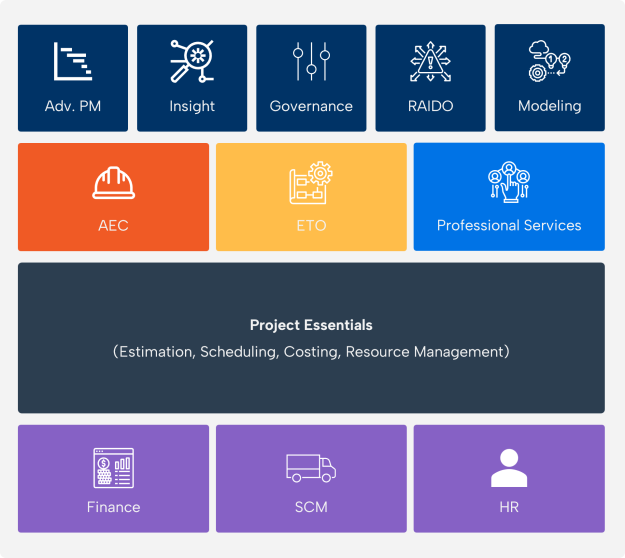
The PlanAutomate stack includes:
- PlanAutomate Essentials: Core project planning, scheduling, budgeting, forecasting, resource management, billing, and financial-control capabilities inside D365 Finance.
- Industry Kits: Additional capabilities designed for specific project workloads, including engineering and construction, engineer-to-order manufacturing, and professional services.
- Advanced Packages: Deeper capabilities for project analytics, AI, governance, earned value management, project modeling, risk management, and portfolio control.
This approach helps companies avoid unnecessary implementation complexity while preserving a path to add more sophisticated capabilities when needed. It also allows project-centric companies to build on one D365 Finance-native foundation instead of adding separate applications as requirements evolve.
Use the to compare PlanAutomate Essentials, industry kits, advanced packages, Dynamics 365 Project Operations, and other project-management options for D365 Finance.
Embedded in D365 Finance
PlanAutomate operates within Dynamics 365 Finance. It is not a separate PSA or project-management platform that must synchronize project and financial data back to the ERP.
This architecture helps companies reduce integration points, duplicate data, reconciliation work, and delays between project activity and financial reporting. It also allows companies to start with the project capabilities they need today and add deeper controls as the business grows.
PlanAutomate does not depend on Dynamics 365 Project Operations as its project-management foundation. Microsoft licensing still depends on the roles and D365 capabilities each user accesses.
PlanAutomate and Dynamics 365 Project Operations
PlanAutomate provides an for project-centric companies using D365 Finance. It is not built on and does not require Project Operations to serve as the operational project-management layer.
Project Operations can fit services organizations focused on project sales, staffing, time, expenses, and PSA-style delivery. PlanAutomate supports a broader project business model inside D365 Finance, with deeper capabilities for:
- Project Financial Control
- Scheduling And Budget Integration
- Forecasting And Estimate at Completion
- Cost Breakdown Structures
- Project Month-End
- Change, Risk, And Issue Management
- Project-Driven Procurement And Manufacturing
- Portfolio Governance And Reporting
PlanAutomate Best Fit
PlanAutomate is designed for project-centric organizations whose financial and operational performance depends on successfully delivering projects. It is particularly relevant for:
- Architecture And Engineering Firms
- Construction And Infrastructure Companies
- Engineer-to-Order Manufacturers
- Aerospace And Defense Companies
- Government Contractors
- Energy And Environmental Services Companies
- Professional Services Organizations
- Other Project-Based Enterprises
PlanAutomate can support companies with sophisticated project-control requirements, but it is not only for unusually complex organizations. Its embedded architecture also makes it a simpler and safer starting point for project companies that want to build on D365 Finance without creating a fragmented application landscape.
Implementation and Support
Adeaca is the exclusive PlanAutomate partner. Adeaca helps project-centric companies assess requirements, design the operating model, implement Microsoft Dynamics 365 Finance and PlanAutomate, manage organizational change, and provide ongoing support.
Adeaca's consultants bring experience across project management, project controls, finance, ERP, supply chain, manufacturing, and Microsoft Dynamics. This allows the team to connect technology decisions with the way project companies actually operate.